Apple Just Put Podcasts on the Television. In the UK, 74% of Video Podcast Viewers Were Already There.
Apple began testing a free video podcasts section for the Apple TV app on Monday. Two days later, IAB UK showed the living room had already won.
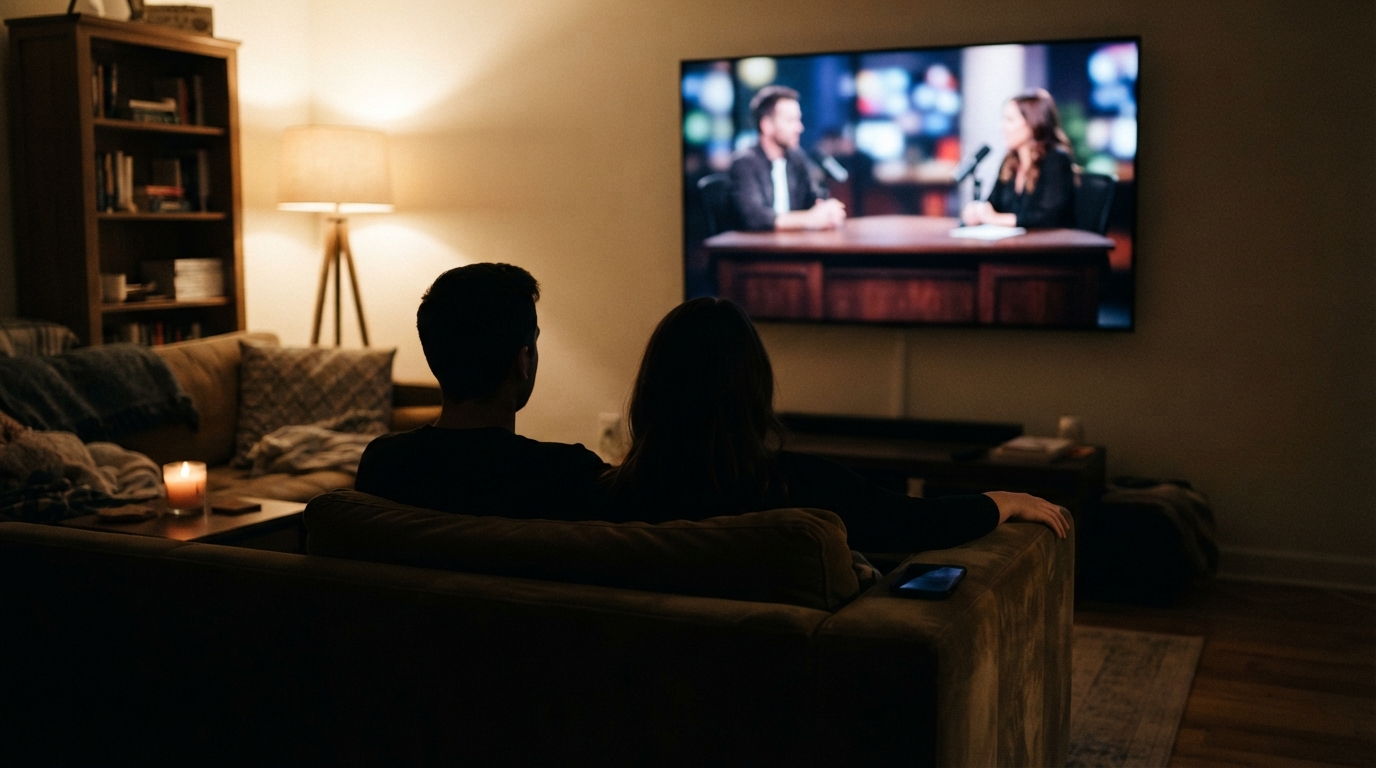
Apple shipped something on Monday that has nothing to do with Apple TV+ and everything to do with where your show gets watched.
A dedicated video podcasts section began developer testing on Monday, November 16, and will later be free to Apple TV app users, including those without an Apple TV+ subscription. According to The New York Times, it will reach more than one billion devices running the Apple TV app, including smart televisions and Roku players.
No subscription. No Apple hardware. The section would later be free through the Apple TV app on Roku devices and smart TVs, without Apple's own TV hardware or a streaming subscription.
Oliver Schusser, Apple's vice president of services, told the Times: "We want podcasts to be available wherever people want to enjoy them — the small screens, big screens." He added that Apple "didn't approach this in a way that would financially benefit us."
No date has been given for the public rollout, and for now only developers can see the new section.
Two days later, the UK data arrived
On Wednesday, IAB UK published Compass research that reframes what that Apple section is actually for.
74% of people who watch video podcasts have done so on a TV screen, and more than a third — 37% — of those who watch on a TV always or often do so with someone else. The findings come from a survey of 1,029 UK podcast consumers, conducted with Walr.
Among 18-34s, that co-viewing figure rises to over half, at 52%.
This is the part that should stop any coach mid-scroll. Audio podcast consumption is overwhelmingly solitary — 87% of listening takes place alone. A show built for earbuds is a one-to-one medium. You are in someone's head while they drive, lift, cook, walk the dog.
Television is not that. Television is a room. Someone else is on the sofa. Someone is half-watching while scrolling. Someone can say "who is this guy?" out loud.
51% of podcast consumers say they will watch on a TV screen in the next year.
The genre data is the uncomfortable bit
The lighter stuff wins the living room. Podcast consumers are far more likely to prefer comedy on video than audio (41% vs 24%), and entertainment shows follow the same pattern. News and politics go the other way, with audio preferred for both — 34% vs 26% for news, and 32% vs 22% for politics.
Most coaching podcasts sit closer to news and politics than to comedy. Instructional. Earnest. Information-dense. Built to be absorbed, not shared across a room at nine in the evening.
Elizabeth Lane, Head of Insight at IAB UK, said people experience podcasts in very different ways, and "advertisers need a different approach for each." Swap "advertisers" for "anyone selling a programme at the end of the episode" and the problem clarifies.
There is a counterweight, and it is encouraging if you have no set, no studio and no production budget. Signal Hill Insights found 39% of video podcast consumers rank seeing hosts and guests interact as the single most valuable on-screen element, above set design, graphics, or production values.
The face matters. The LED panels do not.
Prime time is now podcast time
The living-room shift is not new, it just got an Apple-sized distribution deal this week.
Signal Hill's Pulse Report with FlightStory found 45% of UK monthly podcast consumers had used a smart TV to listen to podcasts in the past month, ahead of smart speakers at 27% and computers at 44% — making smart TVs the second most-used podcast device in Britain.
54% of video podcast consumers watch between 19:00 and 23:00, the weekday evening prime-time window; late afternoon, 16:00 to 19:00, reaches 31%.
And the time is coming from somewhere specific. A majority, 55%, said video podcasts are replacing linear TV and movies, 44% said social media scrolling and short video, and only 15% said it was replacing their audio podcast listening. Researcher Paul Riismandel's read: "Smart TVs are an opportunity for podcasts."
The two biggest shows in the world already made this bet
The timing is almost comic. The same month Apple moved, the YouTube podcast crown changed hands twice.
Raj Shamani's Figuring Out crossed 22 million YouTube subscribers, making it the most-subscribed podcast on the platform globally and the first show worldwide to hit that number. It moved past Steven Bartlett's The Diary of a CEO on 21.9 million and The Joe Rogan Experience on 21.2 million. Figuring Out added 8 million subscribers in 2026 alone — more than a third of its entire base in a single year — and now records 1.4 billion monthly views across platforms.
Bartlett's show went from about 14.2 million subscribers at the end of December 2025 to 21.3 million on 1 November 2026, a rise of roughly 50% in ten months. His site logged the show passing 2 billion YouTube views on 15 November.
Neither of those shows is an audio podcast with a camera pointed at it. Both are television programmes that happen to publish an audio feed. That distinction is about to become expensive.
What breaks when a lead engine moves to the sofa
If your podcast exists to produce discovery calls, three things change on a ten-foot screen.
The link in the show notes stops working. Nobody taps a TV. The call to action has to survive being spoken out loud and remembered until someone picks up a phone.
Your download number starts undercounting you. Signal Hill found 44% of viewers watch with someone else, meaning headline audience figures may significantly undercount actual reach. Two people on a sofa is one play.
And the first thirty seconds get a second job. They now have to hold a person who did not choose the episode.
The upside is real and already measurable. Talk Easy host Sam Fragoso said adding video doubled his show's audience, while NPR's Wild Card has grown by more than 60 percent since Apple introduced the feature. Apple's own data shows more than 35 percent of video podcast consumers switch between watching and listening in a given month.
The decision in front of every coach with a microphone is not whether to add video. It is whether the show is good enough to be on in someone's living room at 9pm, against everything else that could be on instead.
Sources
- Apple TV App to Add Video Podcasts Section Across Over 1 Billion Devices — Analytics Insight
- Apple TV App to Get Video Podcasts Section Today — MacRumors
- Apple TV App to Add Free Video Podcasts, Testing Begins Today — iClarified
- Apple TV App Is Adding Video Podcasts, Starting With Developers — AndroidPure
- Apple TV App Is Getting Free Video Podcasts, Even on Roku — ShiftDelete
- 3 in 4 video podcast viewers watch on the TV as podcasts go prime time — IAB UK
- IAB Compass: Navigating podcasts — IAB UK
- Nearly Half of UK Podcast Consumers Now Watch on Smart TVs — Podnews / Signal Hill Insights
- Prime Time is Podcast Time: Smart TVs and Podcasts in the UK — Signal Hill Insights
- Podcasts Hit U.K. Prime-Time — Sounds Profitable
- Smart TVs overtake computers as Britain's second podcast screen — PPC Land
- Raj Shamani's Figuring Out becomes world's most-subscribed YouTube podcast — Indian Television
- The Diary Of A CEO — News & Stories — StevenBartlett.com
Editor’s note: Two unrelated stories landed 48 hours apart and together they move the goalposts for every coach running a podcast as a lead engine.
Keep reading
Microsoft Just Gave 20,000 Managers a Coach in 70 Countries. The AI One Is Always On.
BetterUp's new Microsoft deal bundles unlimited AI coaching with human one-on-ones — and quietly rewrites what a paid coaching hour has to justify.

The ICF Exam Changed on Tuesday. You Have Until March 31 to Take the Old One — and the Credential Is Identical Either Way.
ICF's redesigned PCC-MCC Exam went live November 10 with knowledge questions at this level for the first time. The old version expires in 19 weeks.

Instagram Is Paying Some YouTubers $500,000. Its Own Boss Says Paying Creators Loses Money.
Meta is funding a handful of big names to launch its 90-minute video format. Adam Mosseri has already explained why everyone else gets nothing.
The SBA Just Put 27 Million Creator Businesses in a Box. The Box Says "Motion Picture."
Washington finally told creators which industry they belong to. If you coach on camera, the deadline to argue with that answer is November 20.